






FULL BODY SILICONE REBORN DOLLS AUSTRALIA

Nurtura

SHOP SILICONE REBORNS AUSTRALIA

Find your Nurtura Baby by style, features, skin tone and size.

BY TYPE
BY FEATURES
BY SKIN TONE
BY SIZE
Mar 11,2026
220+
Young adult deeply focused on work while an untouched lunch sits nearby.

ADHD Hyperfocus: Why Meaningful Interruptions Work Better Than Reminders

You sit down to answer a few emails. The next time you look at the clock, it’s 3:47pm. You haven’t eaten lunch. Your coffee has gone cold. You vaguely remember dismissing a reminder on your phone, but you couldn’t tell anyone what it said.

For many people with ADHD, this experience feels familiar.

Hyperfocus can be one of the most frustrating and misunderstood aspects of ADHD. While it can sometimes lead to incredible productivity, creativity and concentration, it can also make it difficult to notice basic needs such as eating, drinking water, stretching, resting or transitioning to another task.

Most advice focuses on reminders. Set an alarm. Use a timer. Create a calendar notification. Sometimes those strategies work. Sometimes they don’t. Because the challenge isn’t always remembering to take a break. Sometimes the challenge is finding a reason that feels important enough to make you want to.


ADHD isn’t always a problem of attention. Sometimes it’s a problem of switching attention.


Understanding ADHD Hyperfocus

Despite its name, ADHD is not a lack of attention. Many people with ADHD experience challenges regulating their attention. This can result in distractibility in some situations and intense concentration in others.

Researchers often describe hyperfocus as a state of deep absorption in an activity. During periods of hyperfocus, a person may become so engaged in what they are doing that they lose track of time and become less aware of their surroundings.

Hyperfocus can occur while working, gaming, crafting, studying, researching, creating art or engaging in a favourite hobby.

While the experience can feel rewarding, it can also create practical challenges. Meals are missed. Messages go unanswered. Sleep is delayed. Hours disappear without warning.

For some people, the hardest part isn’t getting into hyperfocus. It’s getting out again.

Many people with ADHD know exactly what they need to do. The challenge is often switching attention rather than remembering.

Smartphone notifications and reminders displayed while a person remains deeply focused on a creative task.

Why Reminders Often Fail

Traditional productivity advice assumes that reminders automatically lead to action. People with ADHD know it isn’t always that simple.

A phone alarm may be acknowledged, dismissed or ignored without creating any meaningful change in behaviour.

The reminder is seen. The intention is there. But the transition never happens.

Researchers studying ADHD often refer to challenges with executive functioning, task switching and time blindness. These difficulties can make it harder to stop one activity and move to another, even when the next activity is important.

As a result, many people find themselves searching for strategies that create stronger transition cues than a simple notification.

Most people with ADHD don’t need more reminders.
They need better transitions.


The Difference Between a Reminder and a Responsibility

This is where things become interesting. Imagine your phone reminds you to eat lunch. You might think:

“I’ll do it in five minutes.”

An hour later, you’re still working. Now imagine a different situation. A child needs picking up. The dog needs feeding. Someone is depending on you.

The response is often very different.

The activity is no longer a reminder. It has become a responsibility. Responsibilities create meaning. Meaning often creates action.

This doesn’t mean people with ADHD don’t care about their own wellbeing. In fact, many people describe a strange contradiction where caring for others feels easier than caring for themselves.

They might forget their own lunch. They rarely forget to feed the dog. They might ignore their own reminder. They are much less likely to ignore someone who depends on them.

Hyperfocus can be productive and enjoyable, but it can also make it difficult to notice meals, breaks and other everyday needs.

Young adult deeply focused on work while experiencing ADHD hyperfocus at a home office.

External Accountability and Caregiving

Researchers have long explored the role of external accountability in habit formation and behaviour change. Many people find that routines become easier to maintain when another person, pet or responsibility is involved.

The responsibility itself becomes the cue. This may help explain why some people find caregiving activities meaningful.

The activity creates a natural interruption.

  • A reason to pause.
  • A reason to transition.
  • A reason to step away from the task that has captured their attention.

For some people, that interruption can feel more effective than a timer because it carries emotional significance rather than simply appearing as another notification on a screen.

A reminder says: “Take a break.”
A responsibility says: “Someone needs you.”

From Passive Companionship to Active Responsibility

One of the ideas that inspired The Nurtura Co. was the observation that many people can become completely absorbed in an activity for hours at a time, yet respond almost immediately when they feel responsible for someone else.

A reminder can be ignored. A responsibility is often much harder to dismiss.

Our babies were designed to move between these two states, creating opportunities for both quiet companionship and purposeful engagement.

Passive Companionship and Focus

At one moment, the baby may simply be present.

Many people enjoy holding a baby while working, watching a movie, reading, studying or engaging in a favourite hobby. The realistic weight and gentle newborn sleep sounds create a passive experience that requires very little attention.

In this mode, the baby isn’t asking anything from the user. It simply becomes part of the environment, much like a weighted blanket, comfort object or other familiar sensory support.

When the Relationship Changes

As the audio experience progresses, the interaction can shift from passive companionship to active engagement.

The baby may need feeding, burping, settling or a nappy change. Rather than presenting another alarm or notification on a screen, the caregiving activity creates a meaningful reason to pause and engage.

For some people, this feels very different to a traditional reminder. The interruption has context and purpose rather than simply appearing as another task on a growing to-do list.

Creating Meaningful Transitions

Importantly, these routines are flexible and optional. Users can choose different experiences, adjust difficulty levels and interact with the baby in a way that suits their individual preferences.

For some people, this creates a gentle rhythm throughout the day. There may be extended periods of calm and focus followed by short moments of purposeful engagement before returning to the activity they were already enjoying.

The goal isn’t to interrupt attention for the sake of interruption. Instead, the goal is to create opportunities for transition that feel meaningful, enjoyable and connected to something beyond a flashing reminder on a screen.

For some individuals, caregiving routines and sensory supports may provide stronger transition cues than traditional reminders.
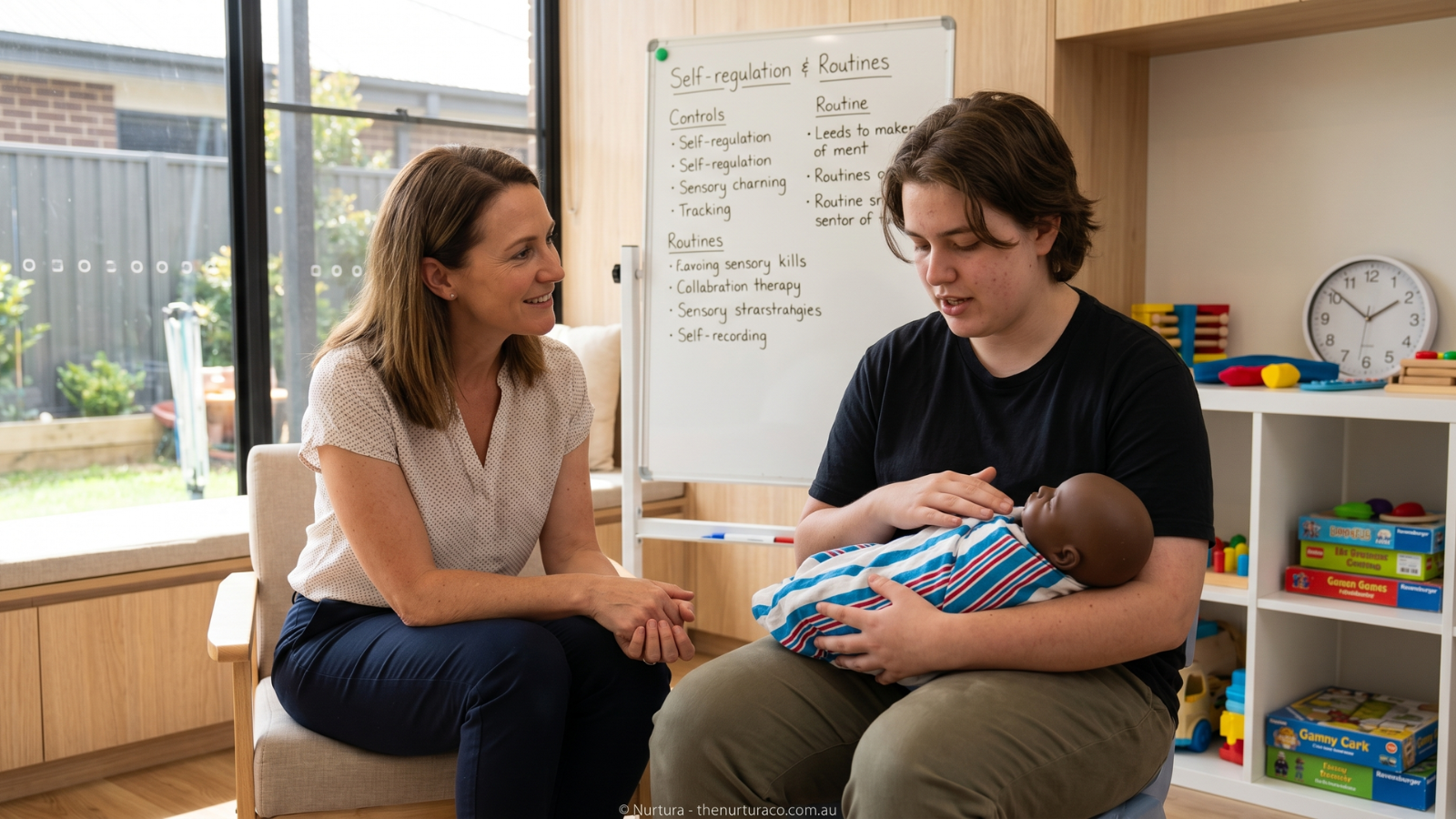
Occupational therapist discussing transition strategies with a client holding a realistic weighted baby doll.

What Does the Research Say?

While there is currently little research examining realistic dolls as tools for supporting attention transitions or ADHD hyperfocus, several related areas of research provide useful insights.

Researchers studying ADHD have identified challenges with executive functioning, task switching and time blindness as common experiences for many individuals. These challenges can make it difficult to move from one activity to another, even when a person is aware that they should take a break.

Research has also explored the role of external accountability in behaviour change. Studies examining habit formation suggest that people are often more likely to follow through on actions when they involve responsibility, caregiving or commitments to others rather than relying solely on internal motivation.

Similarly, researchers investigating pet ownership have found that caring responsibilities can help create routines, structure and daily habits. While caring for a doll is clearly different from caring for a living animal, the underlying concept of responsibility as a behavioural cue may help explain why some people respond differently to caregiving activities than they do to traditional reminders.

Other studies have examined the role of external prompts and environmental supports in helping people with ADHD manage transitions and daily routines. These supports are often most effective when they feel meaningful, personalised and relevant to the individual.

Taken together, this research suggests that successful transition strategies may depend on more than simply remembering what needs to be done. The emotional significance of the cue may matter just as much as the cue itself.

Further reading:

The Goal Isn’t to Stop Hyperfocus

Hyperfocus is not always the enemy.

Many people value the creativity, enjoyment and productivity that can come with becoming deeply immersed in an activity. The goal isn’t necessarily to eliminate hyperfocus. The goal is to create healthier ways to move in and out of it.

  • To notice when basic needs are being neglected.
  • To create opportunities for rest, movement and self-care.
  • To build routines that support wellbeing without constantly fighting against the way the brain naturally works.

The goal isn’t to stop hyperfocus.
The goal is learning how to move in and out of it.

Finding What Works for You

There is no universal solution for ADHD hyperfocus. Some people use timers, visual schedules, movement breaks, body doubling or accountability partners. Others develop routines that help create natural opportunities to transition between activities throughout the day.

What matters most is finding strategies that feel meaningful enough to interrupt your attention and support the shift to whatever comes next.

For some people, that might be a timer. For others, it may be a responsibility, a routine or a caregiving activity that provides a stronger reason to pause and re-engage with the world around them.

Because sometimes the challenge isn’t remembering to take a break.

It’s having a reason to take one.


For Occupational Therapists, Behaviour Support Practitioners and Educators

While this article focuses on the lived experience of ADHD hyperfocus, the concepts explored here may also be relevant to professionals supporting individuals with attention regulation, executive functioning or transition challenges.

If you’re interested in exploring how realistic weighted dolls and interactive caregiving experiences may be used within educational, wellbeing or support settings, we’d love to hear from you.

Learn more about our education and professional solutions, request a demonstration or discuss how The Nurtura Co. babies are being used in different settings.

Explore Comfort, Connection and Discovery

At Nurtura, our babies are designed to be experienced, not displayed. Combining realistic newborn-inspired features, full body silicone construction, immersive sound experiences and a focus on meaningful interaction, Nurtura babies are created for comfort, connection and discovery. Explore The Nursery to discover a different approach to realistic dolls.

April 10, 2026
NURTURA IS COMING!
Cart (0 items)
Cart (0 items)